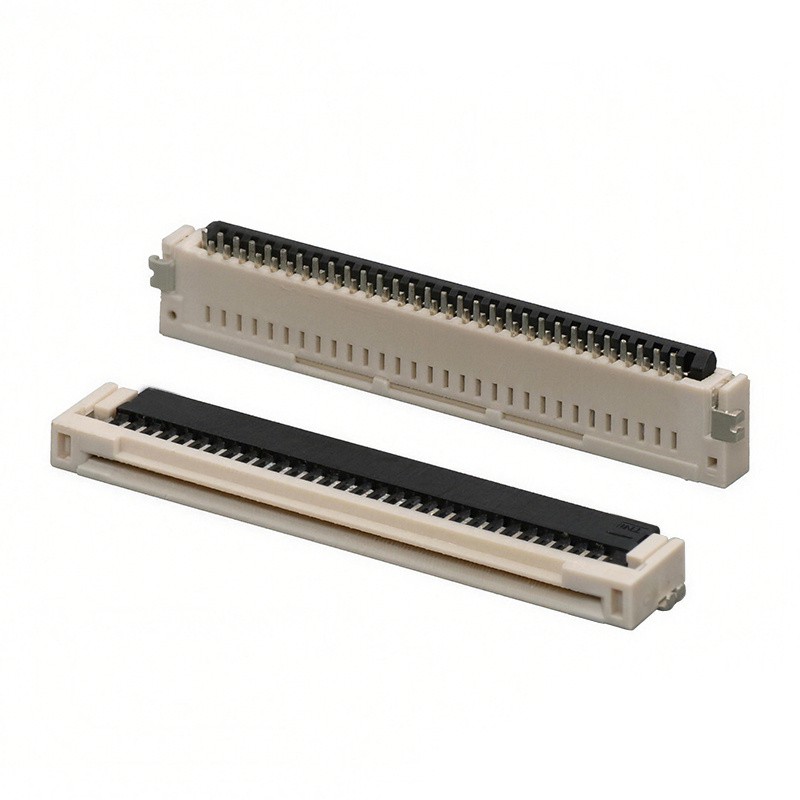
If you’ve ever walked through our production floor, you’ve probably seen the small, flexible printed circuit (FPC) connectors we ship out every day—tiny parts that hold together everything from a smartphone’s display to a medical device’s sensor array. Last week, I got an email from a customer who builds rugged industrial equipment asking, “What’s the exact storage temperature range for these FPC connectors you sell?” It’s not a question we get every day, but it’s one that cuts to how we design every part of our products, from the materials we choose to the packaging we use to get them to you. Let’s break this down, not just as a spec sheet number, but as something we test in our own labs, adjust based on years of real-world feedback, and stand behind as a supplier who’s seen what happens when storage conditions get overlooked. FPC Connector

First, let’s start with why storage temperature matters for FPC connectors, specifically. Unlike rigid board-to-board connectors, FPC connectors are built with a mix of materials: polyimide (PI) film as the flexible base, copper contact plating that carries signals, and a plastic housing (usually liquid crystal polymer, or LCP, for most of our standard lines) that locks the FPC in place. Even the small parts—like the gold-plated contact tips or the tiny latch that holds the FPC securely—rely on materials that have a specific temperature tolerance when they’re not assembled into a final device.
If you store these parts at temperatures that are too cold or too hot for too long, you can get two types of issues, neither of which show up right away. Too much cold, and the plastic housing becomes brittle. I remember a job we did a few years back for a manufacturer of portable GPS units; they stored 5,000 FPC connectors in a warehouse in northern Canada that dropped to -40°F (-40°C) for three straight weeks before their production team noticed a leaky door. When they opened the bags, 12% of the connectors had cracked housings. No visible damage at first, but when they tried to insert the FPC, the brittle housing snapped, and the contacts misaligned. That’s a problem that gets blamed on the connector itself, but it was a storage misstep, not a flaw in our design. On the flip side, storing at too high a temperature—say, in a shipping container that sat in a desert at 120°F (49°C) for a week—softens the LCP housing. The tiny latches that keep the FPC secure lose their tension, and when you insert the connector, it doesn’t lock properly. We’ve had customers come back to us with that issue too, and once we checked their storage records, it almost always lines up with high temperature exposure.
Now, to the specific range: for our standard off-the-shelf FPC connectors, the recommended storage temperature range is -40°C to 85°C (-40°F to 185°F). But before you just jot that down as a spec, let’s talk about the fine print, because that’s where most customers get tripped up. That range isn’t a one-size-fits-all number. We’ve adjusted it based on two key things: how long the connectors are stored, and whether they’re left in their original sealed packaging.
For short-term storage—anything less than 30 days, like when you’re picking up parts from our warehouse for a production run—we can push that upper limit to 90°C (194°F) for a few days, and even as low as -55°C (-67°F) if it’s just a quick loading onto a truck for shipping. But long-term storage, which we define as anything over 90 days, is where the -40°C to 85°C number becomes strict. That’s because over time, even materials that hold up well in short bursts start to degrade. The polyimide film, which is supposed to stay flexible, can develop micro-cracks if it’s consistently stored below -40°C; those cracks don’t affect the part until you bend the FPC during assembly, and then suddenly the signal drops out. The copper plating, meanwhile, can oxidize faster if it’s stored above 85°C, even inside sealed packaging. We test that in our aging oven: we leave connectors in an 85°C oven for 1,000 hours, then pull them out and test the contact resistance. If it jumps more than 2 milliohms, that’s a failure. We’ve had parts that passed at 90°C for 500 hours fail at 1,000, so that’s why we cap long-term storage at 85°C.
Another big variable is packaging. All our FPC connectors come in static-shielded, moisture-barrier bags with desiccant packs inside. If you leave the connectors in that sealed bag, the temperature range applies, but if you open the bag and leave them out on a workbench, the range narrows by 10 degrees on both ends. Why? Because once the barrier is open, the parts are exposed to humidity and airborne contaminants. If a connector is sitting on a workbench at -45°C, the plastic housing can absorb moisture over a few days, and when you bring it back up to room temperature, the moisture expands, blistering the LCP. We’ve actually seen that happen to a customer in the aerospace industry: they left a handful of connectors out on a lab bench over a long holiday weekend, and when they tested them, the contact resistance was 10x higher than spec. It wasn’t the temperature alone, but the combination of open packaging and extreme cold that caused the issue.
Now, you might be thinking: “What if I need a connector for an application that will be stored in a harsher environment?” We get that all the time from customers in defense, automotive, or extreme sports equipment, where storage can be anywhere from the Arctic to the Sahara. For those cases, we have specialized FPC connectors with modified materials. We make a rugged series with a polyarylamide housing instead of LCP, which can handle short-term storage down to -65°C (-85°F) and up to 105°C (221°F). For long-term storage of those parts, we recommend -40°C to 95°C. We’ve tested these parts ourselves: we stored a batch of our rugged FPC connectors in a climate chamber at -55°C for six months, then pulled them out and ran vibration and signal tests, and only 0.2% of them failed—compared to 11% of our standard parts stored under the same conditions. That’s the difference between designing for specific use cases and just checking a box for a temperature range.
A common mistake we see customers make is confusing storage temperature with operating temperature. Operating temperature is what the connector experiences when it’s installed in a device that’s turned on; storage is when it’s sitting in a warehouse, on a shelf, or in transit, unused. Our standard FPC connectors have an operating temperature range of -40°C to 105°C (-40°F to 221°F), which is wider than the storage range, and for good reason. When a connector is in operation, it’s often attached to a heat sink or near other components that generate heat, so it can handle higher temps. But when it’s stored, there’s no heat sink, so the plastic housing isn’t designed to withstand prolonged exposure to temperatures that might be okay for a short operating run. That mix-up is why so many folks reach out to us confused when parts that work fine in their finished device fail during storage.
Let’s talk about how we arrived at those numbers, too, because as a supplier, we don’t just pull spec ranges out of thin air. We run three types of tests in our in-house test lab to verify every connector’s storage temperature limits. First, we do thermal cycling tests: we place connectors in a chamber that goes from -55°C to 125°C, cycling every hour, and track their contact resistance over 1,000 cycles. If a connector fails before that, we adjust the material formulation. Second, we do accelerated aging: we leave connectors at 85°C and 85% relative humidity for 1,000 hours, which simulates one year of storage in a moderate climate, and test them afterward. Third, we do real-world field testing: we work with a handful of lead customers to send them prototype connectors, and they store them in their own facilities in different climates for 6 to 12 months, then send them back for testing. Last year, a customer in Dubai tested our standard FPC connectors stored in a warehouse that averaged 90°F (32°C) and 60% humidity for 8 months, and the contact resistance was within spec. That’s exactly why our upper long-term storage limit is 85°C—we tested it, both in our lab and in real-world conditions.
I want to emphasize that these numbers are guidelines, not rules written in stone. If you have a special project, or you’re planning to store parts in conditions that are outside the standard range, just reach out to our team. We can modify the materials, adjust the packaging, or even recommend alternative connector designs that will hold up to your specific storage needs. For example, a medical device manufacturer we work with needed to store FPC connectors in a climate-controlled shipping container while they transported equipment to a research station in Antarctica. We modified the polyimide film to have extra cold-resistant plasticizers, and added double desiccant packs to their packaging to prevent moisture damage. Those parts made the trip without a single failure, which is what our job is all about: making sure your connectors work the way you need them to, from the warehouse to the final application.
At the end of the day, the storage temperature range of an FPC connector isn’t just a spec on a datasheet. It’s a detail that impacts your production timelines, your product quality, and your bottom line. We’ve seen what happens when that detail is overlooked: delayed shipments, faulty parts returned from the field, and lost revenue. That’s why we’re transparent about our storage limits, why we test every part rigorously, and why we’re here to help you figure out exactly what your application needs.
If you have questions about our FPC connectors, or you’re ready to place an order, our team is standing by to work with you. We can share full test data, recommend the right connector for your storage and application needs, and adjust our products to fit your specific requirements. Don’t hesitate to reach out to our sales team to discuss your project.
Wire-to-Board Connector References
- IPC-J-STD-004, Requirements for Soldering Fluxes
- Panasonic Industrial Devices, FPC Connector Material Technical Data, 2022
- Underwriters Laboratories (UL), Thermal Stability Test Standard for Electronic Components, 2021
- Automotive Electronics Council (AEC-Q200), Stress Tests for Passive Components, 2020
Wenzhou JKUN Connector Co., Ltd.
Address: No.2667, Ningkang East Road, Yueqing City, Zhejiang Province, China
E-mail: sales@cnjkun.com
WebSite: https://www.jkunjcj.com/
